Compare
Paldar vs CoachAccountable
How Paldar differs from CoachAccountable, when CoachAccountable is the better choice, and why one runs a coaching practice client by client while the other designs and measures whole development programs.
4 November 20264 min readBy Jonah Cacioppe, assisted by Claude

CoachAccountable and Paldar are both built for people who deliver coaching and development for a living, and both care about what happens between sessions, not only in them. CoachAccountable is coaching practice software that has been refined since 2012. It runs the day to day of a coaching business: scheduling, session notes, action plans, worksheets, contracts, invoicing and a branded client portal, for a solo coach or a whole coaching team.
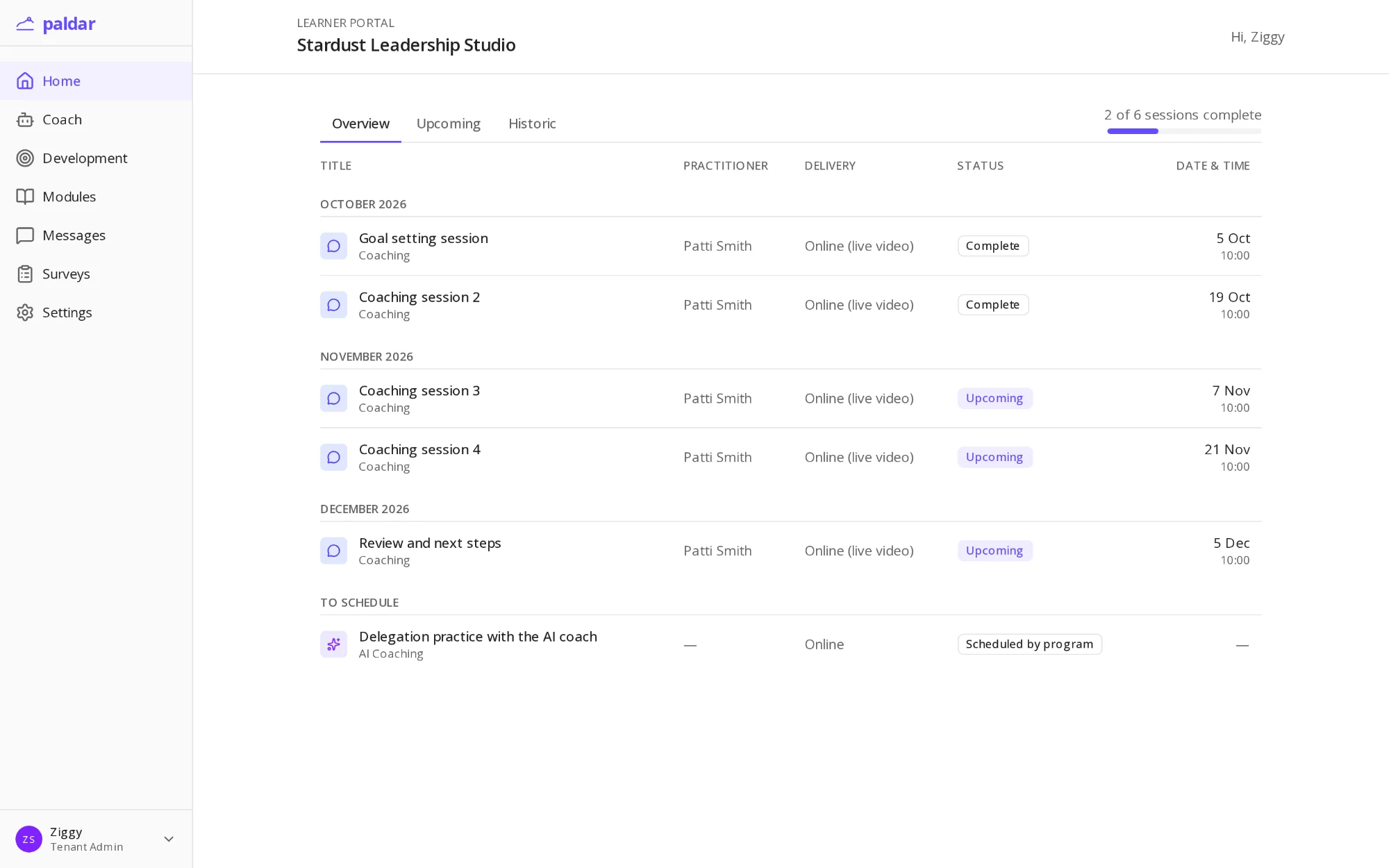
Paldar is software for the people who design and deliver development programs: coaching and leadership practices, and internal learning and development teams. A program in Paldar has a cohort, a team of practitioners, a sequence of workshops, coaching, surveys and lessons, and a measured result on the capabilities it set out to build.
So the real question is not which tool is better. It is whether your work is organised around individual coaching clients, or around programs that a group of people move through together.
| Feature | PaldarTeam plan | CoachAccountable |
|---|---|---|
| Design and run | ||
| Program designer and templates | Courses and action plans | |
| Component library | ||
| Unlimited projects and programs | ||
| Unlimited participants | ||
| Automated reminders | ||
| Program components | ||
| Coaching | ||
| AI coaching | Paid Learner Plan | |
| AI Coach Email | ||
| Chief | ||
| Chief and Coach email inboxes | ||
| Chief with an autonomous inbox | Enterprise | |
| Surveys | ||
| Post-session | ||
| Post-program | ||
| Outcome measure | ||
| Practice management | ||
| Proposals, quotes and deals | ||
| Client organisation records | ||
| Financials and margin per project | ||
| Notes on programs, people and quotes | ||
| Team roles and collaboration | ||
| Integrations | ||
| Accounting sync with Xero, QuickBooks and MYOB | Upcoming | |
| CRM integrations | Enterprise | |
| Notion task sync | Upcoming | |
| Join the waitlist |
What CoachAccountable is good at
Running a coaching practice end to end. Scheduling syncs with Google, Outlook and Apple calendars, with SMS and email reminders and an embeddable booking widget. Digital agreements carry signatures, timestamps and tamper prevention. Invoicing covers recurring billing, installments, packages and company billing, paid through your own Stripe, Square or PayPal account.
Accountability between sessions. Action plans with due dates and reminders, client metrics tracked against a target, worksheets and journaling, shared files and group coaching spaces give clients real structure after the call ends. Courses can drip content on a calendar or step by step.
Coaching teams. Team Edition adds unlimited coaches and administrators at no extra cost, precise coach and client pairing, shared templates and courses from a master coach, and reports such as coach touchpoints and logged coaching hours.
Simple, published pricing. Every plan has every feature, and the price depends only on active clients, from $20 a month for 2 clients to $4,000 a month for 1,000. There are no setup fees and a 30 day free trial.
A clear position on data. CoachAccountable states it uses no AI or machine learning on coaching content, is GDPR compliant, is hosted in a SOC 2 certified data centre and was last pen tested in February 2025. It also says plainly that it is not HIPAA compliant and does not offer single sign on.
If you run a coaching practice and want a mature, well supported system for clients, sessions, contracts and billing, CoachAccountable is a strong choice, and Paldar is not trying to replace it.
Where the fit is harder
It is built around the client, not the program. Each person is a client record with their own appointments, actions and metrics. A leadership program for a cohort of 24 managers, with workshops, coaching, a 360 at the start and a follow up measure at the end, has to be assembled from groups, courses and individual records.
Measurement is per client. Metrics and forms track what each client reports, which suits coaching accountability. There is no 360 feedback on the published feature checklist, and no capability framework that shows how a whole cohort moved from baseline to follow up.
No AI support between sessions. This is a deliberate choice CoachAccountable explains on its tour, and some coaches and clients will prefer it. Practices that want AI nudges or coaching conversations between sessions will need to look elsewhere.
Cost follows client numbers. Because the price scales with active clients and each group member counts separately, a practice running large cohorts pays more as programs grow, even though coaches and administrators are free.
What Paldar is built around
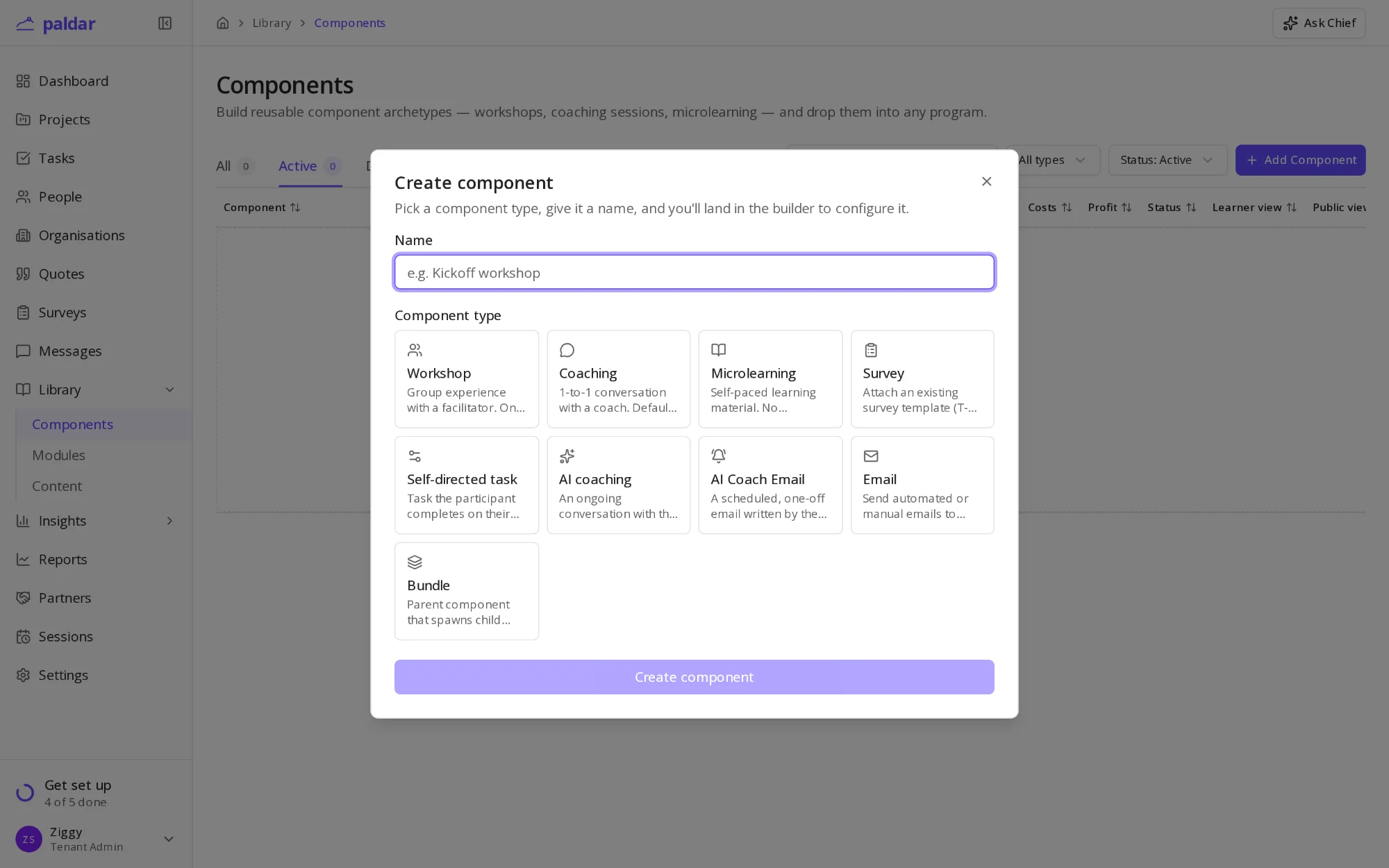
Your program, your people. You design a program as a table of interventions: workshops, coaching sessions, surveys and 360s, lessons and reminders, each linked to the capabilities it serves. Your own practitioners deliver it, and participants are invited, scheduled and measured from it.
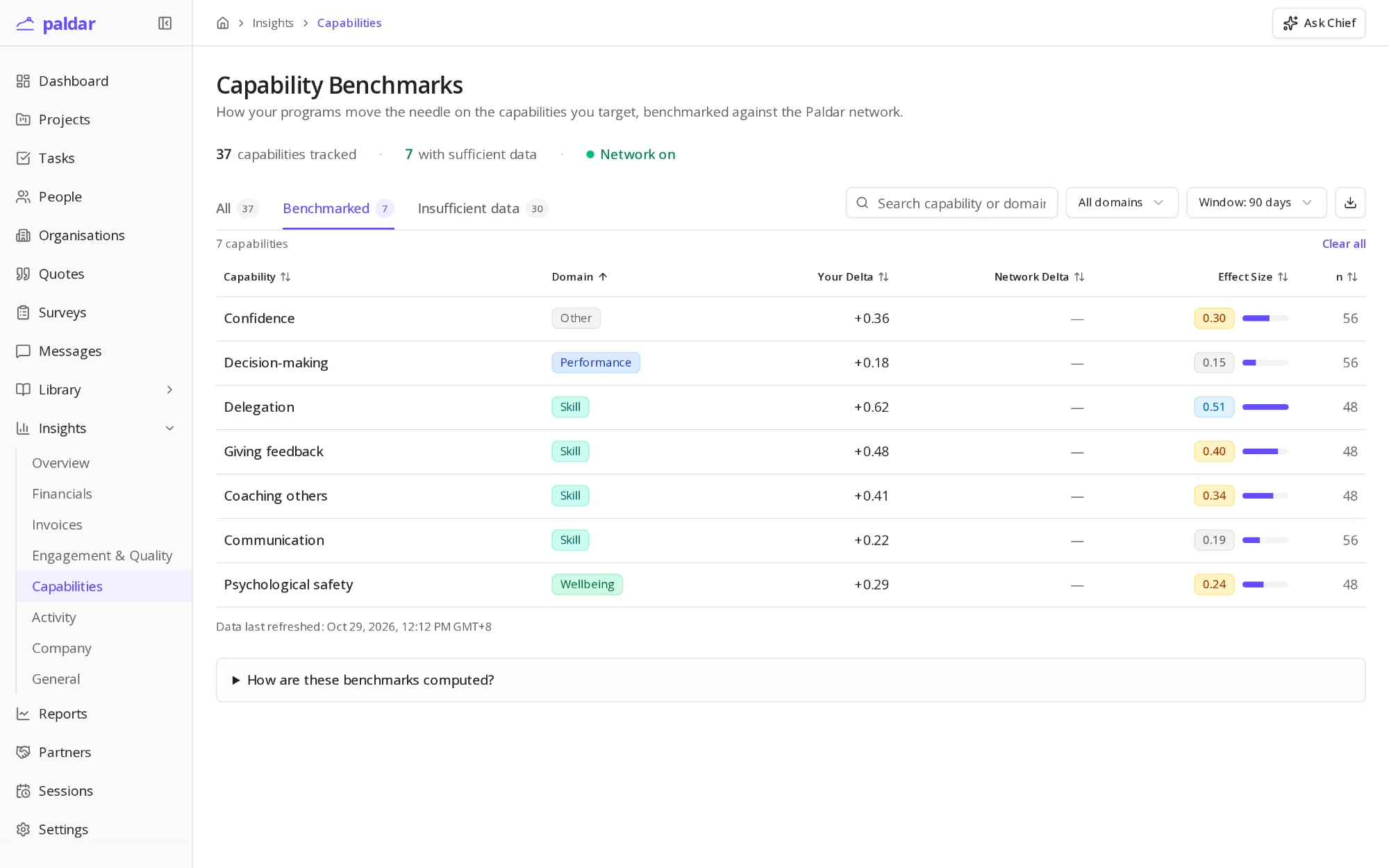
Measurement of change. Custom surveys and 360s map to capabilities, so the result of a program is movement on each one from baseline to follow up, ready to show a sponsor or a client.
AI between sessions, under your control. Paldar's coach supports each participant between sessions by email or in app, following the program you designed and personalised for each learner.
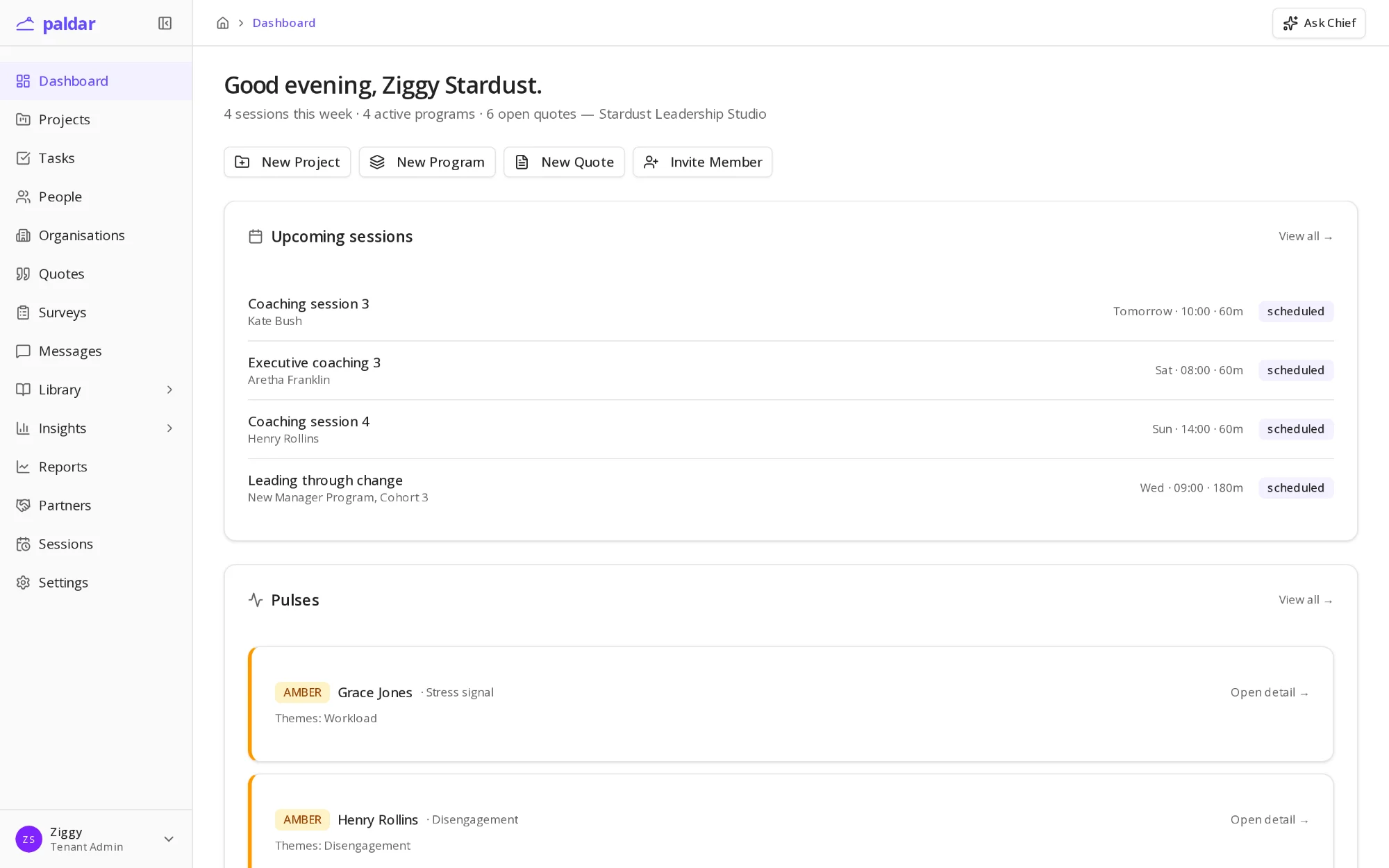
The business around the work. Proposals, quotes, client organisations and margin per project sit next to the programs they come from. The Team plan is $15 per practitioner per month, with unlimited participants.
Choosing between them
Choose CoachAccountable when your practice is built on one to one and small group coaching relationships, and you want a dependable system for booking, notes, accountability, contracts and payment.
Choose Paldar when you design and deliver blended development programs for cohorts, for your own organisation or for clients, and want one place to run them and prove they changed behaviour. Paldar is new, and we would rather you join the waitlist knowing exactly where it fits.
Related reading
All comparisons →